

Trade & Tariff Update: USMCA Enters a New Era of Uncertainty
)
Trump Administration Declines to Renew USMCA, Triggering Annual Review Process
On July 1, the United States formally declined to renew the U.S.-Mexico-Canada Agreement (USMCA) in its current form, triggering a new annual review process that could last for up to a decade.
The decision does not immediately terminate the USMCA. The agreement remains in force through July 2036 unless the United States, Canada, and Mexico reach an agreement to extend it before then. Current preferential tariff treatment remains available, existing rules of origin continue to apply, and companies do not need to change customs filing practices today.
However, the decision is still a major development. Instead of extending the USMCA for another 16 years, the three countries will now meet annually to review the agreement and negotiate potential changes. That process introduces year-over-year uncertainty for companies that depend on predictable North American trade rules.
For the business and professional events industry, this matters for two reasons.
- First, the USMCA supports the movement of goods across North America. Exhibitions, conferences, trade shows, and other business events depend on cross-border supply chains for exhibit materials, staging, signage, furniture, technology, promotional products, food and beverage inputs, and countless other event-related goods.
- Second, the USMCA is part of a broader economic relationship that supports the movement of people. Canada and Mexico are two of the most important international markets for U.S. business events. Cross-border attendees, exhibitors, sponsors, speakers, buyers, sellers, suppliers, and event partners are essential to the success of many U.S.-based events.
That is why the growing uncertainty around the USMCA is important for the U.S. business and professional events industry.
What Has Not Changed
The most important near-term point is that the USMCA remains in effect.
That means:
- Current USMCA preferential tariff treatment remains available.
- Goods that qualify under existing rules of origin can continue receiving USMCA benefits.
- Existing automotive, agricultural, manufacturing, and other trade flows continue under current rules.
- Companies do not need to modify customs practices solely because of the July 1 announcement.
- USMCA’s dispute settlement and compliance mechanisms remain in place.
In other words, the July 1 decision does not create an immediate cliff. Goods do not suddenly lose USMCA treatment. North American trade does not immediately revert to a pre-USMCA or pre-NAFTA environment.
However, it does start the clock on a much more uncertain period.
What Has Changed
The biggest change is that the USMCA now enters an annual review process.
Under USMCA’s review and sunset provisions, the agreement was scheduled for a six-year joint review on July 1, 2026. If all three countries had agreed to extend the agreement, USMCA would have been renewed for another 16 years. Because the United States declined to do so, the agreement now moves into annual reviews and will expire in July 2036 unless the parties reach a renewal agreement before then.
That creates several new risks for the business community.
- Annual negotiations mean annual uncertainty. Companies that make sourcing, investment, pricing, and event-planning decisions months or years in advance will have to monitor each review cycle for potential changes.
- Rules of origin may become more restrictive. The Trump administration has signaled interest in stronger North American and U.S.-specific content requirements, particularly in autos, metals, and other strategic sectors.
- Canada and Mexico may be treated differently. Administration officials have indicated interest in pursuing separate 10-year trade deals with Canada and Mexico. Both countries have rejected that approach, but even the possibility of diverging rules creates uncertainty for companies that treat North America as one integrated market.
- Sector-specific disputes could intensify. Negotiations with Mexico have already focused on automotive rules of origin, steel and aluminum, agriculture, and economic security concerns related to China. Talks with Canada appear less advanced and more difficult.
For the events industry, the concern is not limited to one product category or one sector. The concern is that the rules governing North American trade could become less predictable across the board.
Why USMCA Matters to the Business Events Industry
The USMCA is not just a trade agreement for manufacturers, farmers, and automakers. It is a foundation for the broader North American economy.
Business events sit at the center of that economy.
Every year, U.S. exhibitions and conferences bring together buyers and sellers from across North America. Canadian and Mexican companies exhibit at U.S. trade shows. Canadian and Mexican attendees travel to U.S. conferences. U.S. suppliers support events in all three countries. Event organizers depend on reliable cross-border movement of goods and people.
When North American trade works well, the business events industry benefits. When North American trade becomes uncertain, fragmented, or politically unstable, the business events industry feels it.
A single major U.S. trade show can involve exhibitors from Canada, Mexico, and dozens of other countries; materials sourced from multiple jurisdictions; temporary imports; customs brokers; general service contractors; transportation providers; international attendees; and multinational sponsors. Even modest changes to tariff treatment, sourcing rules, or customs requirements can create new costs and delays.
That is especially true because many event-related goods are time-sensitive. If a booth component, display system, printed material, piece of equipment, or promotional product is delayed at the border, there may be no practical backup option. A missed delivery window can mean missed business opportunities.
USMCA helps reduce that risk. Preserving a stable, trilateral agreement should be a priority for policymakers in all three countries.
The Canada Problem Is Bigger Than Tariffs
Canada is one of the most important international markets for the U.S. business events industry. Canadian attendees, exhibitors, speakers, sponsors, and suppliers are critical participants in many U.S.-based exhibitions and conferences.
But the ongoing trade and tariff dispute has already affected more than goods. It has affected how Canadians view travel to the United States.
Recent Oxford Economics analysis of Statistics Canada data shows that Canadian visitor arrivals to the United States have been significantly below historical averages. The chart shows both air and land arrivals declining, with land arrivals especially hard hit. In several recent months, Canadian land arrivals have been roughly 30% to 40% below historical averages, while air arrivals have also remained meaningfully depressed.
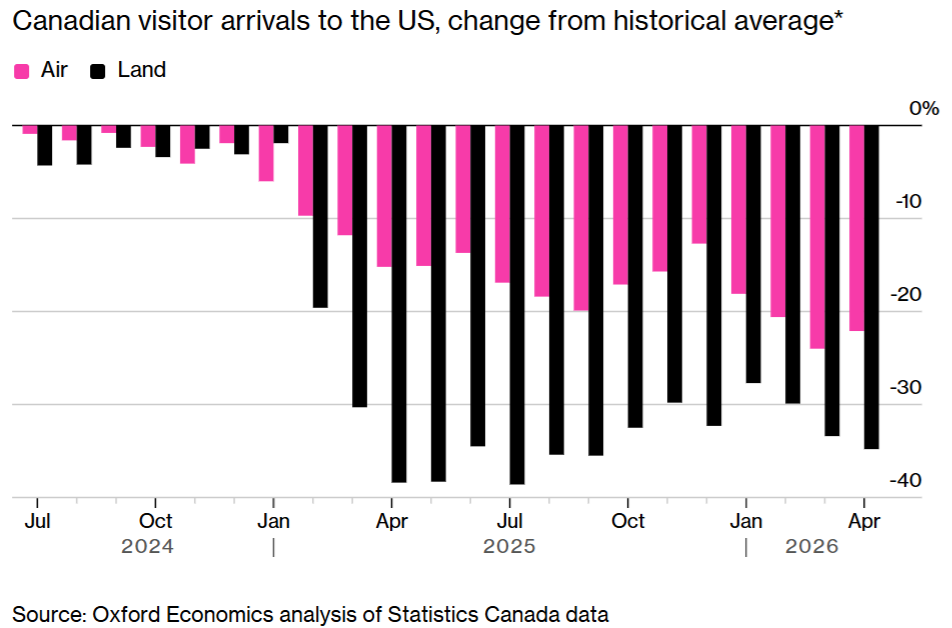
Canadian attendance is not a nice-to-have for many U.S. events. It is part of what makes those events international, commercially valuable, and attractive to exhibitors. Fewer Canadian visitors can mean fewer buyers on the show floor, fewer cross-border business meetings, fewer international sponsors, and weaker event return on investment.
Mexico Negotiations Are Moving, But With Major Issues on the Table
The United States and Mexico have already begun USMCA review talks.
The first round took place in late May, followed by a second round in Washington, D.C., in mid-June. A third round is expected in Mexico City during the week of July 20.
Key issues include automotive rules of origin, steel and aluminum manufacturing, agricultural trade, and economic security concerns related to China. The Trump administration has pushed for stronger content requirements, including higher North American and U.S.-specific content thresholds in the automotive sector.
Those proposals may seem far removed from the events industry at first glance. They are not.
The broader direction of travel policy matters. If the USMCA becomes more restrictive, more administratively burdensome, or more fragmented, companies throughout the economy will need to spend more time and money proving compliance. Those costs can flow through supply chains and ultimately affect event organizers, exhibitors, suppliers, and attendees.
Mexico has also drawn red lines in key areas, including seasonal agricultural restrictions. That matters because event venues, hotels, restaurants, and convention centers are also sensitive to food and beverage costs. New agricultural trade frictions could add pressure to already complicated event budgets.
Canada Talks Remain Less Certain
The Canada track is more uncertain.
The Trump administration has not yet launched a formal USMCA review process with Canada comparable to the Mexico talks. U.S. officials have publicly criticized Canada’s engagement, while Canadian officials have continued informal discussions with their U.S. counterparts.
This creates a distinct risk: North America could move away from a single trilateral framework and toward separate arrangements with Canada and Mexico, which would be a major step backward.
For decades, North American trade has been built around the idea that companies can treat the United States, Canada, and Mexico as one deeply integrated regional market. That approach has supported manufacturing, agriculture, logistics, retail, energy, tourism, and business events.
A two-track approach could create diverging rules, timelines, documentation requirements, and compliance obligations. For companies that operate across all three markets, that would make North America more complicated, not more competitive.
For the business events industry, fragmentation would be especially harmful. Events often bring together companies, products, and people from all three countries at the same time. A predictable trilateral framework is far more useful than a patchwork of bilateral arrangements.
Why Annual Reviews Are Bad for Long-Term Planning
Major exhibitions and conferences are often booked years in advance. Venues are contracted, sponsors are secured, exhibitors make participation decisions, international marketing campaigns are launched, and supply chains are built around fixed event dates.
The same is true for many companies that participate in these events. Exhibitors plan product launches, international sales campaigns, buyer meetings, and major purchases around trade shows and conferences. Suppliers make investments in equipment, inventory, labor, transportation, and technology based on expected demand.
Annual USMCA reviews make that planning harder.
A company considering a five-year investment in North American sourcing now has to account for the possibility that trade rules may change every year. An exhibitor deciding whether to participate in a U.S. event may have to consider whether cross-border costs, customs rules, or tariff treatment could shift before the event takes place. A Canadian or Mexican company evaluating a major U.S. trade show may have to weigh not only the value of the event but also the state of the bilateral relationship.
That uncertainty can chill investment. It can also chill participation.
ECA’s Perspective
ECA supports policies that strengthen the competitiveness of the U.S. business and professional events industry. That includes trade policies that keep North America open, predictable, and commercially integrated.
ECA encourages the United States to work with Canada and Mexico to preserve the USMCA as a strong trilateral agreement. Policymakers should avoid unnecessary disruption to cross-border supply chains, international travel, and business relationships.
ECA recognizes that trade agreements can and should be reviewed. If there are legitimate concerns about rules of origin, forced labor, transshipment, or unfair trade practices, those concerns should be addressed in a targeted and practical way.
But the answer should not be a decade of uncertainty.
A stable USMCA supports U.S. businesses, workers, exporters, event organizers, exhibitors, suppliers, and destinations. It supports cross-border commerce. It supports international participation in U.S. events. It supports the ability of the United States to remain a global leader in business events.
The administration should prioritize renewal of the USMCA, maintain a trilateral framework, and avoid using tariffs or annual review threats in ways that undermine confidence in the North American market.
What Event Industry Stakeholders Should Watch
ECA will continue monitoring USMCA developments closely, including the following:
- Whether the United States opens a formal review process with Canada.
- Whether the administration continues pursuing separate bilateral arrangements with Canada and Mexico.
- Proposed changes to rules of origin and regional content requirements.
- New documentation or customs compliance burdens.
- Potential changes affecting steel, aluminum, autos, agriculture, consumer products, and other event-related supply chains.
- Canadian travel trends to the United States.
- The July 20 U.S.-Mexico negotiating round in Mexico City.
- Any congressional engagement related to USMCA renewal or modification.